Reviewed November 3, 2026. Gutter Installation St. Louis is a referral service; independent contractors do the work.
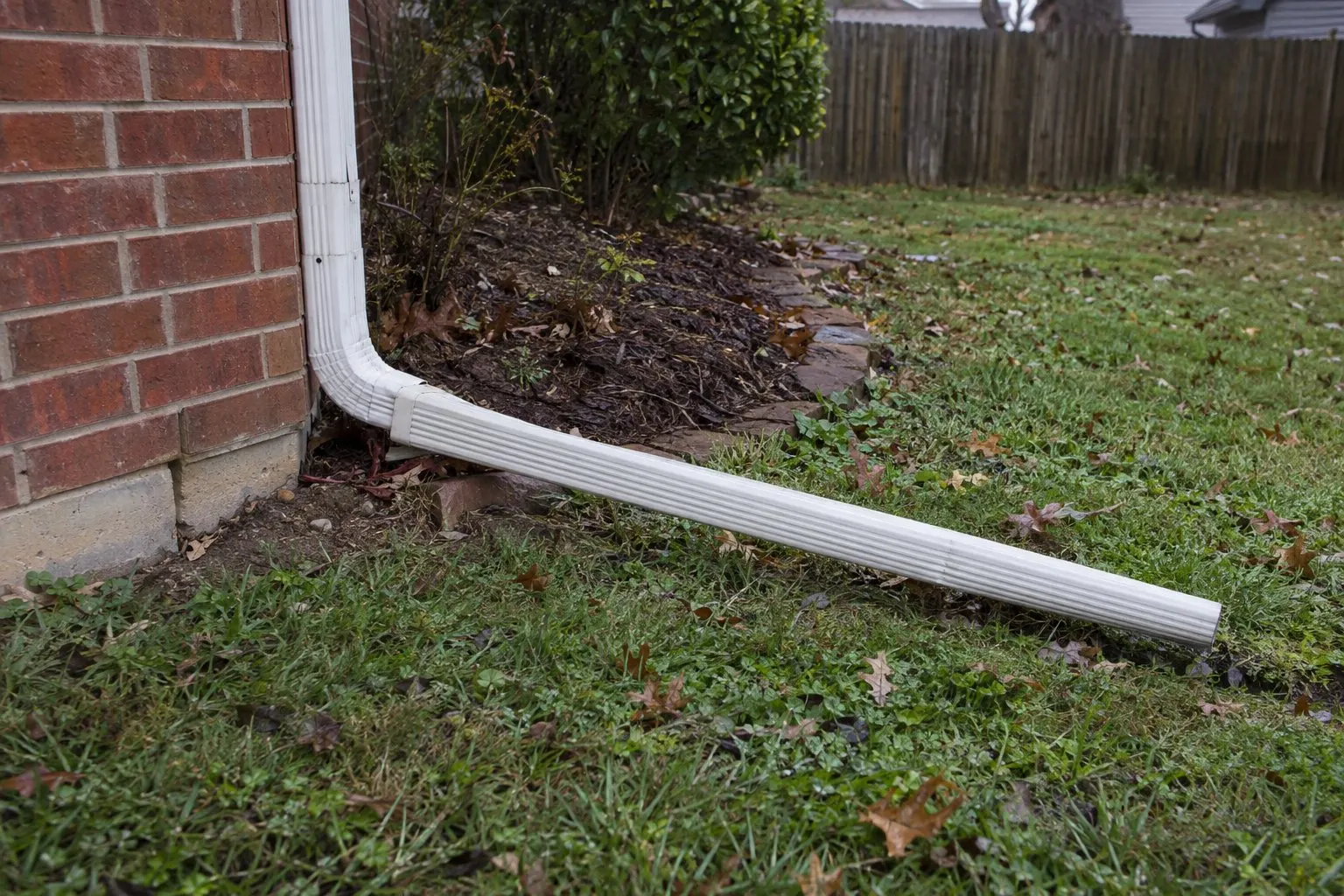
Roof water should leave the downspout and move away from the house across ground that falls away. It must not run into a sanitary sewer: the Metropolitan St. Louis Sewer District says those connections break its ordinance and local building codes and must be removed. Extensions, splash blocks and properly planned drain lines are the usual tools. In a tight city gangway, the choice takes more thought.
- Don't
- Connect a downspout to a sanitary sewer lateral
- Usual options
- Extensions, splash blocks, buried lines to a legal outlet
- Watch
- Icy walks, neighbors, basement walls
- If you got a letter
- Read the MSD guide
- Price
- Set by the contractor, in writing. See how quotes work.
Downspouts and drainage are the last part of a gutter system: they take roof water from the trough to somewhere safe. On St. Louis houses that often means dealing with old foundations, tight lots and pipes that were once tied into the sewer.
How much does downspout and drainage work cost in St. Louis?
We have no St. Louis drainage price we can stand behind, and contractors set their own. A new extension above ground is a very different job from a buried line, so what moves the quote is how far the water has to travel, what the ground is like, and any digging. Ask for each downspout's route and end point in writing. How to read a St. Louis gutter quote shows what to look for.
Can a downspout go into the sewer in St. Louis?
Many old St. Louis houses have downspouts that vanish into a pipe at ground level. Some of those run to the building's sewer lateral. MSD Project Clear lists downspouts among the connections that can send stormwater into wastewater lines, says these connections break its Sewer Use Ordinance as well as local building codes, and says it writes to owners when it finds one. In project areas, it says it will remove significant connections without penalty and at no cost for a limited time, with the owner's permission (MSD).
So before anyone ties new gutters into an old pipe, ask where that pipe goes. A dye or camera test can answer it. Our MSD guide walks through it.
Where can a downspout drain instead?
- Extensions and splash blocks. Cheap and easy to check. They need room, and they get mown over.
- Flip-up or roll-out extensions. Handy where a path or mower crosses.
- Re-routing. Moving a downspout to a side with better fall can solve more than an extension does.
- Rain barrels. Useful in the growing season. They need an overflow and must be drained before freezes.
Should you bury downspout lines?
A buried line is tidy, but it's only as good as its outlet and fall. It should end somewhere water can legally and safely leave, not on a neighbor. It needs a way to be cleaned, and in winter a shallow, flat line can hold water and freeze. Ask where it ends, how deep it runs and how it gets cleared. Ask your city as well, since rules for discharging toward a street or alley vary.
What about tight lots and wet basements?
Older city houses often have stone foundations and very little yard. A downspout that empties into a narrow gangway can soak the wall on both sides. On those lots the answer may be fewer downspouts in the gangway and more at the front or rear. If a basement is wet, fix the roof water first, because it's the cheapest thing to rule out. If water still comes in, you may need a waterproofing specialist or an engineer. A gutter contractor can't answer that.
What happens to downspouts in winter?
With 84.8 nights a year at or below freezing, a downspout that dumps across a walkway becomes a slip hazard. Check where the water goes in December as well as in May.
Ask for a downspouts & drainage quote
Tell us about the house. If an independent contractor can take the job, they contact you directly.