Reviewed November 3, 2026. Gutter Installation St. Louis is a referral service; independent contractors do the work.
A new gutter system should carry roof water to downspouts and then well away from the walls. In St. Louis, the things that set a good job apart are how it fastens to old masonry and trim, how it copes with about 85 freezing nights a year, and where the water ends up. Ask for a measured, written quote. Independent contractors do the work; this site only passes on your request.
- Usual choice
- Seamless aluminum, 5-inch or 6-inch K-style
- Old-house options
- Half-round or copper, box gutter repair
- Permit
- Usually none in the City, unless a historic district applies. Elsewhere, ask your city.
- Price
- Get it in writing. See how quotes work.
- Who does it
- An independent contractor. We pass on your request.
A St. Louis gutter has a harder life than its size suggests. Federal climate normals for Lambert airport show 41.7 inches of precipitation a year, with April, May and June the wettest months, and 84.8 days with a low at or below freezing. On most of those days the afternoon climbs back above 32°F, so anything wet in the trough freezes and thaws over and over. (NOAA normals)
Add housing that often predates the gutter by a century, and installation here is less about hanging metal than about deciding what the house needs. This page walks through those decisions so you can judge a quote.
What kind of house do you have?
The first question decides most of the others.
| House | What's usually different | Ask about |
|---|---|---|
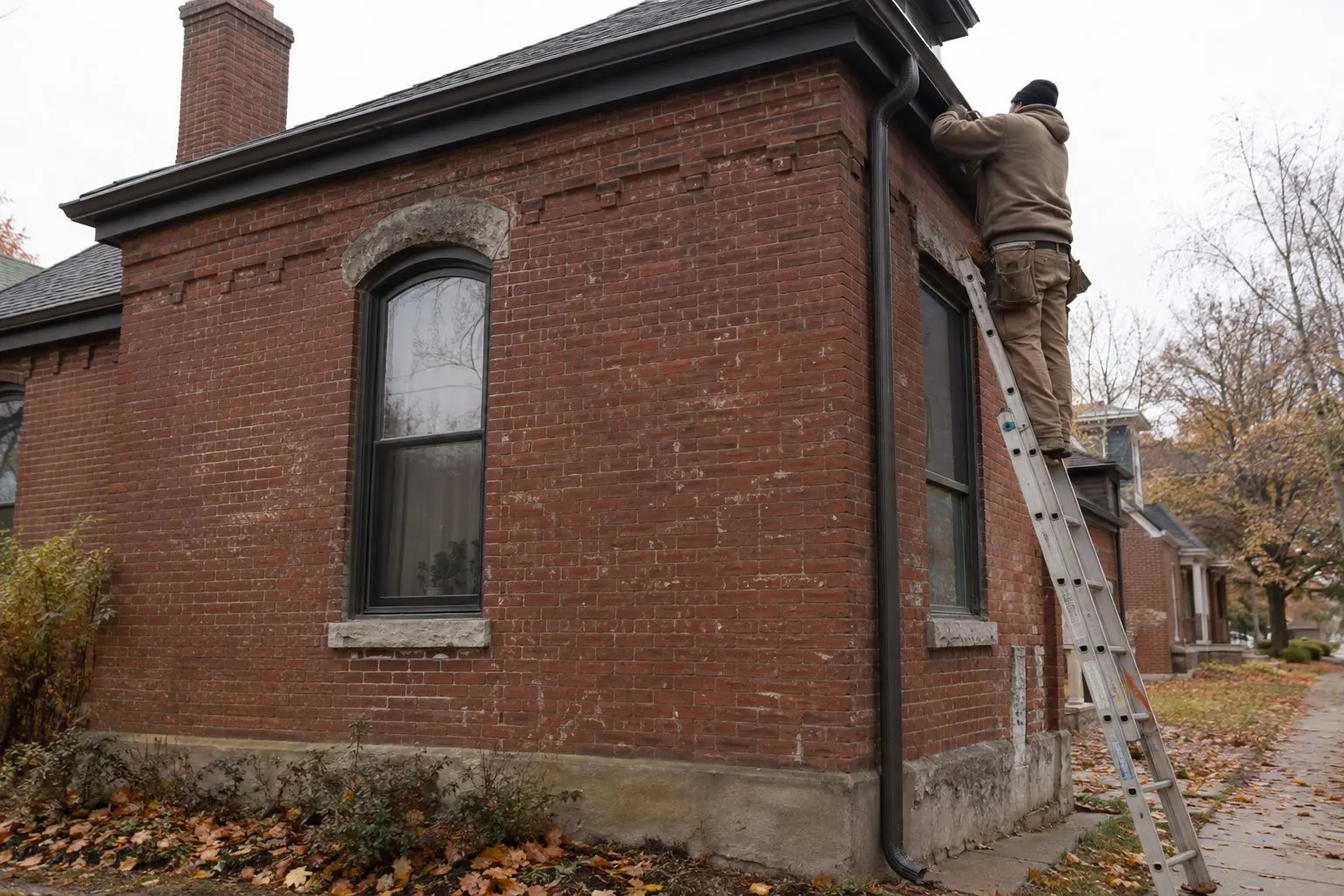
| Soft-brick city house, 1850s to 1920s | Often a wood cornice or no real fascia, and old mortar | Fastening method, cornice repair, hidden box gutters |
| Brick bungalow or two-family, 1920s to 1940s | Short eaves, tight gangways between houses | Where downspouts can go without flooding the walk |
| Postwar ranch | Long low eaves, wood fascia, often an older gutter layout | Fascia condition, added downspouts, yard drainage |
| 1990s or newer two-story | Big roof sections and valleys that dump into one corner | 6-inch gutters, larger downspouts, valley splash guards |
Should it be 5-inch or 6-inch?
Gutters are sized by how wide the trough is at its open top. Five-inch K-style suits many smaller roofs. Six-inch carries more water and suits large or steep roof sections, long runs and corners where valleys concentrate the flow. The arithmetic is simple: one inch of rain on 1,000 square feet of roof is about 623 gallons, and Lambert averages 11 days a year with an inch or more. Downspout size matters as much as trough size, because a big gutter draining through a small outlet still overflows.
Ask the contractor to size the system from your roof areas and pitch, and to tell you why. The sizing guide has the questions to raise.
How will it fasten to the house?
On a wood fascia, hidden hangers screwed into sound wood are the common choice. Spikes through the face of the gutter are the older method, and they tend to work loose. Sound wood is the key phrase, because a hanger is only as good as what it bites.
Old brick is different. Downspout straps have to fix to the wall somewhere, and historic soft brick can be damaged by careless drilling. Ask whether fixings go into mortar joints or the brick face, how many there will be, and what happens to the old holes. Our guide to gutters on old brick homes goes further.
What about ice?
Metal contracts and expands through every cycle, joints get worked, and a gutter pitched too flat holds water that then freezes. A good layout keeps a steady fall to each outlet, avoids long flat runs and gives every section a downspout it can reach. Ice at the eave can also point to heat escaping through the roof, which no gutter fixes. See ice dams and freeze and thaw.
Where does the water go?
A gutter only moves the problem unless the downspout finishes somewhere sensible. In St. Louis that has an extra twist: the Metropolitan St. Louis Sewer District says stormwater connections from downspouts to a sanitary lateral break its Sewer Use Ordinance and local building codes and must be removed. So an old pipe disappearing into the ground deserves a question before new gutters are tied into it. Read downspouts and MSD rules.
Do you need a permit?
The City of St. Louis lists gutter and downspout repair or replacement among work that usually needs no permit. The exception matters here: on a property in a City Historic District or a City Landmark, its guidance says the Cultural Resources Office requires approval to protect the building's exterior. In St. Louis County and St. Charles County, each city has its own desk. The permit guide lists who to ask.
What does it cost?
Angi's St. Louis page puts the average for seamless gutters at about $1,094, with a usual range of $856 to $1,331 (Angi). Treat that as a starting point only. Height, corners, downspouts, removal of the old system and trim repair all move the figure, and a three-story brick house with a rotten cornice is not the average house. How to read a St. Louis gutter quote explains the lines to look for.
What to ask the contractor
- Will you measure at the house and put it in writing?Ask for footage, gutter size, metal thickness, color, hanger type and spacing, downspout count and size, removal, and any trim repair as separate lines. Ask if the estimate is free.
- How will you fix to my brick or trim?Get the method in plain words, including what happens to soft brick and rotten fascia.
- Where will each downspout discharge?Walk it together. Ask what happens to any old pipe going into the ground.
- Who checks permit and historic rules?Ask who checks and who applies, before you sign.
- Can I see proof of insurance?Ask for the certificate and confirm it with the insurer, as Webster Groves advises.
- Will you flush it with me watching?Ask for water through each run, and hold the final payment until it drains.
Installation around St. Louis
Each page covers that place's houses, trees and permit desk.
City of St. Louis
- Soulard
- Lafayette Square
- Benton Park
- Tower Grove South
- Shaw
- Central West End
- The Hill
- Dogtown
- St. Louis Hills
- Carondelet
St. Louis County
- Clayton
- University City
- Webster Groves
- Kirkwood
- Maplewood
- Ladue
- Creve Coeur
- Chesterfield
- Ballwin
- Affton
- Oakville
- Florissant
St. Charles County
Installation: questions
How long does gutter installation take?
Ask the contractor, because it depends on the house. A simple one-story job can be short, while tall brick walls, cornice repairs or a historic review add time. Get the start date and expected finish in the written agreement, and allow for weather.
Are seamless gutters better for St. Louis?
Usually. With no joints along the straight runs, there are fewer places for freeze and thaw to open up a leak. Corners and outlets still have joints. See seamless gutters for the differences and for when sectional still makes sense.
What color should I pick for a brick house?
Many owners match the trim or choose a dark bronze that recedes against old brick. Inside a City Historic District, ask the Cultural Resources Office first, since each district has its own standards.
Can gutters go on a house with no fascia board?
Often, using brackets or straps fixed to the roof deck, rafter ends or the wall, but the method matters on old masonry. Some old houses were built with box gutters instead. Ask the contractor to show you what is up there before quoting.
When is the best time to install?
Any dry spell works for the gutter. Requests tend to bunch up in autumn before leaf fall and after spring storms, so asking early gives you more time to compare quotes.
Do I need more than one quote?
It's wise. The City of Webster Groves advises getting written estimates from at least three contractors, comparing materials and methods, and being wary of bids far above or below the rest.
Further reading
- What do new gutters cost in St. Louis, and how do you read a quote?
- How to check a gutter contractor in Missouri
- Do you need a permit for gutters in St. Louis?
- Gutters on old St. Louis brick homes
- Ice dams and freeze and thaw: what St. Louis winters do to gutters
- Downspouts and MSD: can yours stay connected to the sewer?
- What size gutter does a St. Louis roof need?
Related work
- Seamless Gutters: Continuous runs formed at your house from a coil of metal, with joints only at corners and outlets.
- Gutter Replacement: Taking the old system off and starting again, including whatever the removal uncovers underneath.
- Downspouts & Drainage: Getting roof water away from old foundations and out of the sanitary sewer, without sending it to the neighbor.
- Box Gutter Repair: Gutters built into the cornice of older houses. When they fail, water goes straight into the wall.